Sunday, December 7, 2014

Living the Present, Calvary, with Passion (2 of 3)

The aims of the Year for Consecrated Life, to look at the past with thanksgiving, to live the present with passion, and to embrace to the future with hope, beautifully coincide with St Bernard's, "three comings of Christ" taken from his famous Advent Sermon. In this post (2 of 3) I will look at living the present, Calvary, with passion.

St Bernard says that the "intermediate coming," i.e. the present one, is invisible and more illusive than the other two. For this reason it is much easier missed, or expected to be a display of omnipotence rather than the presence of the Crucified Lord, recognizable only in the lives of those who believe:
"It is invisible, while the other two are visible...In his first coming our Lord came in our flesh and in our weakness; in this middle coming he comes in spirit and in power; in the final coming he will be seen in glory and majesty."
Above you see typical Filipino children: joyful, poor, playful, in search of food as much as they are in search of adventure. I live at a seminary here in rural rice farming community of Camarines Sur, Philippines, and almost every time I go into Naga City, I encounter very young street children. They always have a way of waking and shaking me up, of calling me out of myself, and making me aware of the present situation.

The present situation is Calvary. God does not appear in glory as the just judge, not yet. He comes to us in disguise as a beggar, asking for our attention, for a scrap of love. The truth of the eternal and perfect unconditional love of God is not known, the face of the Kingdom Christ came to share is marred often beyond recognition.

In the Philippines, the bishops have declared, "The Year of the Poor." In the message for this year, "The Gaze of the Crucified Lord," we read:
"Behold Jesus, poor. No image of Jesus, poor, surpasses this one. Jesus hangs from his Cross stripped of his clothes, his dignity, his possessions, his power, his strength. He is fully one with the unwashed, the oppressed, the scorned, the powerless, the miserable, the outcaste. In the Year of the Poor, look into the eyes of the crucified Lord. There is no experience richer."
Jesus Christ in his disguise has to intrude into our lives in order for us to even be aware of the present. Yesterday I had two such little messengers on the street intrude. I felt my leg being flicked, and I didn't have to look down to know what that meant. I saw two smiling boys, brothers arm in arm, begging for food. They were there to remind me once again of the present moment, of my own present moment, of my own poverty, and responding in compassion was the only way I could truly reply, and still call myself a man consecrated to God. We were right next to a street vendor selling corn on the cob. I bought them one, broke it in half and said in their dialect, "Jesus loves you. Be good and stay out of trouble." Many of the street children sniff glue to blunt their pain or commit petty thefts. I looked up and there was a group of people smiling at me to actually see a religious taking care of the very ones for whom he ought have preference. It was a wake up shake up experience reminding me of who I am.

Living the Present in the Passion of Christ

Are you aware of what is going on right now from God's perspective (the only objective one)? In the Church, in the world, even in your soul according to God's grace? To say that you do, is to lapse into presumption. Because sin, not only divides us from God, from each other, and even from ourselves, not only are we truly not present to God, to our neighbor, but we cannot say that we are even really present to ourselves. We are not present to the present.

As the Advent collect reads, "since we have no merits of our own," we need the merits of Jesus Christ, that he obtained for us by his Most Sacred Passion, in order to be present to the present. It is also his glorious disguise of poverty, littleness, and vulnerability, that intrudes into our narrow scope of existence to wake us and shake us up.

A consecrated person, is a person that has woken up, that has been made aware of what is really going on, most especially made aware of the real crucified face of the love of God. The love of God in the present moment appears very poor, does not put on heirs, is not sophisticated and streamlined, but is the humblest thing beyond our imaginings. It is only a person who has truly woken up, that can, as Pope Francis is asking of consecrated persons this year, "Wake up the World!"

The other great wake up call that consecrated men and women have are their vows, particularly that of obedience. If I want to really understand my own situation I need to look at my obedience. What is God asking of me right now? What is he focussing me on? What is my daily bread, my daily sacrificial offering of my life entail? I should ask, what is my assignment?

Superiors really are THE prophet in our lives. They are the authenticated representative of God's providential Will, that mediate to us what God is really asking of us, and what he is not asking of us. Married people have this too, which comes from their vows to each other. In serving married couples, I ask them to be very careful of their wife or husband, of what they are saying, desiring, or asking of them, because there is no greater prophet who mediates God's will than the one they have been vowed to obey.

Granted, the deeper vows of our baptism that have bound us to the Most Holy Trinity are an even more primordial prophet that reveal God's ultimate Will, but the vows we have taken to obey the particular and specific present community, person, and circumstance, reveals the true cross that we have been asked to carry.

This is made even more clear when a spouse, or even a superior, God forbid, is unfaithful, or lacking in any way to their vows of baptism, for what they lack, we are asked to fill up in the beauty of true love's ugliness, i.e. its real sacrifice, the one we never thought of when we were first engaged, or in our novitiate, when love's discovery of the other was only in principle and novelty. Please don't misunderstand me, many times it is not a superior who is unfaithful, for they are usually chosen for being upright and level-headed, but they frequently ask of us to do difficult things, to reveal love where there is not, to bring fidelity where there is not, be hope where there is not.

This where we see the present, that it is really Calvary, and the demands of what love, true love, of which St Paul says, "bears all things" is asking us to carry. This too is where secondary causes such as superiors or spouses reveal the first and final cause, the Love of God, which obedience and the radical demands of this Love, are the only thing that can free us and reveal to us the reality of the present Calvary.

How to LIve the Present with the Passion of Christ

God's plan of consecrating our poverty to God will undoubtedly bring us to the Passion of Christ. The source, summit, and center of consecrated life is Jesus Christ in the Most Holy Eucharist. There the treasure chest of merits of his Sacred Passion are wide open to us. There we appropriate the sufferings, joys, hopes, lights, and glories of our life into eternal life, where we truly realize the present moment with Passion.

The Sacrament of Confession too is where the merits of the Savior are applied to us particularly, where Jesus is present to our naked poverty, who we really are, men and women in need of his mercy.

The poor also are the living crucifixes, to remind us, to wake us and shake us up, that we make shake up and wake up this world, that is in most desperate need of God.

Community life! What a crucifixion, what a glory! It is the place where we can either be sucked dry or fanned into flame that was once given us. God is calling each community to go to the Passion of Christ collectively. It calls for consecrated persons to courageously enter into a frank and open dialogue with the members of their household and not fear to honestly and charitably make an examination of conscience, not pointing the finger, but lifting each other up with helping hands, as we encounter our brother's and sister's poverty through the lens of our own poverty, the invitation to respond in love, "for by bearing one another's burdens we fulfill the law of Christ" (Gal 6:2).

Finally the Church, now more than ever, is experiencing its own poverty. Ecclesiastical crucifixions are ever so common, where circumstances in communities, particularly scandals against chastity, poverty, and obedience rock the foundations of the Church. Here we are asked to respond with charity's particularly mature prudence and a very firm resolve to not fail to be present to the Church. For the redemption the Redeemer is leading his consecrated people through at this point in history, could only be to wake up and shake up the world, as to its own desperate need for redemption.

May God grant us saints! That is what is needed now more than ever, that the grace of consecration, of public profession of the vows of chastity, poverty, and obedience.

May Our Lady of the Most Holy Trinity, bring each consecrated man and woman to be on fire with Christ's Passion, and bring forth a harvest of holiness for the redemption of all mankind!

Saturday, December 6, 2014

Looking at the Past, at Bethlehem, with Thanksgiving (1 of 3)

Pope Francis in his Message for the Year of Consecrated Life gave three aims: to look to the past with thanksgiving, live the present with passion, and embrace the future with hope.

St Bernard said there are three comings of the Lord:
We know that there are three comings of the Lord. The third lies between the other two. It is invisible, while the other two are visible...In his first coming our Lord came in our flesh and in our weakness; in this middle coming he comes in spirit and in power; in the final coming he will be seen in glory and majesty.
It struck me how these truly fit together:

1st coming: Bethelehem
2nd coming: Sacraments
3rd: Final Judgement
View Past with Thanks
Live Present with Passion
Embrace Future with Hope

I am going to do a three part series on each of these comings, on each of these aims of this Year of consecrated life.  This first post looking back toward Bethlehem at the birth of Christ and at the birth of my religious family, the Society of Our Lady of the Most Holy Trinity.  In looking back, the words of Pope Francis are a beautiful guide:
"Recounting our history is essential for preserving our identity, for strengthening our unity as a family and our common sense of belonging.  More than an exercise in archaeology or the cultivation of mere nostalgia, it calls for following in the footsteps of past generations in order to grasp the high ideals, and the vision and values which inspired them, beginning with the founders and foundresses and the first communities.  In this way we come to see how the charism has been lived over the years, the creativity it has sparked, the difficulties it encountered and the concrete ways those difficulties were surmounted.  We may also encounter cases of inconsistency, the result of human weakness and even at times a neglect of some essential aspects of the charism.  Yet everything proves instructive and, taken as a whole, acts as a summons to conversion.  To tell our story is to praise God and to thank him for all his gifts." -Message for the Year of Consecrated Life
What is so striking about the birth of the Virgin Mary's baby, the Incarnate God, in the cold dark cave of Bethlehem is his poverty, littleness, vulnerability, that his birth was accompanied by rejection, placed in a manger where animals were kept.  This perhaps also could describe the birth of the Society of Our Lady of the Most Holy Trinity, or I suppose, the beginnings of any religious community.  It begins in littleness, poverty, and vulnerability, and is usually accompanied by rejection and survives by being kept in the humblest of places.

Life begins small, in seminal form, and no one quite knows what it will become.  Even if you you look at a pinecone and know it will become a tall pine tree, you don't know quite what shape the branches will take, or even if it will survive being planted.  The beginning is a very delicate time.  

As I recall the history of my community, what takes shape is a kind of particular geography, or specific landscape, of thanksgiving.  Taking the Holy Father's aims personally did the same for me.  A few days after being ordained a deacon, I made a 7 day retreat.  The sole meditation of the retreat, was simply recalling my life in SOLT.  I had with me an iPod, in which a picture of each member was stored.  I simply looked at the face of each member of my community and tried to see the face of Jesus Christ.  What happened was amazing.  Of course, I did see, as the Holy Father, suggested, some short-comings and inconsistencies, but more prominent was the mercy of God in each person's life, how God had called each one to become part of something much greater than themselves, to be a member of a religious family.

Once again, one night here in the seminary during Eucharistic Adoration, I looked back at the past 14 years of my life in the Society of Our Lady of the Most Holy Trinity, trying to recall each assignment, and person or family that I met, all the members, especially my teammates, the religious sisters, permanent brothers, priests, consecrated widows, permanent married deacons, single and family laity, even the men and women in formation who are no longer with the community with whom I have had contact.  What arose in me from this kind of recalling was a very deep hymn of praise and thanksgiving to the Most Holy Trinity.  "How can I repay the Lord for his goodness to me?  The cup of salvation I will raise, I will call on the Lord's name."

I would encourage every consecrated person to try this: recall not only the history of your community, but your own history in it, making it as specific as your memory will allow. I suppose it is really like looking back on that covenant that God has made with you, like an old married couple, or perhaps newlywed if you are freshly professed.  Two things tend to happen, the acceptance of your own littleness, poverty, and need for God, and the recognition of God's faithfulness, his grace and mercy.

Perhaps you need to take this time to also forgive anyone who has hurt you in any way in your community. People bump up against each other. That is what we do. It is unavoidable. With faith we can see always and in ever situation, the primary cause and final end of each moment in history, Jesus Christ, the Lord of history, history's true goal, the final end of each person, and their true completion and perfection. If this is so, then it is easy to find the Love of Christ to forgive them. It is then that we sincerely ask God for the grace to truly look at the past with thanksgiving, not merely as a religious exercise, but as a reality that becomes enshrined in our hearts as a purified memory. God makes all things new. Even the way we look back at past events.

May this Year of Consecrated Life bring forth a hymn of praise and thankgiving to God, Father, Son, and Holy Spirit.  May Our Lady of the Most Holy Trinity accompany us and guide us to live our consecration to give God the maximum glory possible.

Friday, December 5, 2014

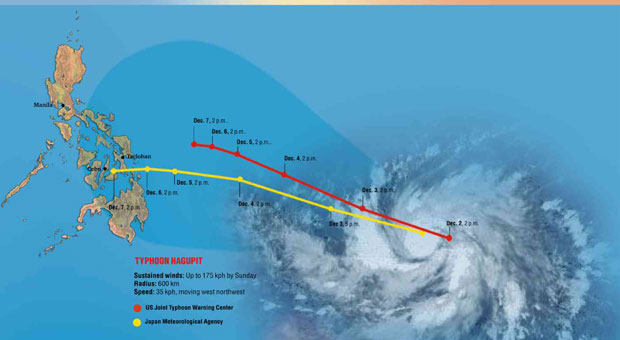
Batten Down the Hatches, Hagupit Has Introduced herself


My window is now sealed and a Benedictine Cross guards the shutters. The only time I have ever shut my windows is with a typhoon. I've done so because Supertyphoon Hagupit (known locally as Ruby - yes Filipinos like knick names), has said hello. Fast gusts of wind, rain falling horizontally and then disappearing and calming down again - this storm has introduced herself.

Even though the official landfall isn't until tomorrow night at this time (Saturday 5-6pm) because she is so big, we have already started to enjoy her presence. She is said to be 700km or 445 miles wide.

I just finished shopping for the 100 people soon expected to arrive here, an official typhoon shelter. The brothers are in an extra ordinary good humor. I love to see them this way, it is in crisis that they have shone the most. Really the best has started coming out if these future priests. It is difficult to describe the magnanimous hope this engenders to see such a thing. God is very much alive and moving in amazing ways in their lives for the life of the Church.

Please continue to pray for the aversion of this storm. St Faustina, the "Secretary of Divine Mercy'" was told by The Lord Jesus, that the prayer of Divine Mercy, the offering to the Father the sacrifice of Jesus on the Cross, is particularly helpful to calm storms and avert disasters.

Tomorrow, first Saturday of the Month, we will still host the 2000 hail Mary's in reparation and supplication for the salvation of the world. Then on Sunday night we will host an all-night Vigil in honor of the Solemnity of the Immaculate Conception.

It is quite a beautiful thing to pray amidst such fury. We did the same when typhoon Glenda hit. Perhaps one of the most riveting experiences of my life was leading, or rather shouting at the top of my lungs amidst the raging typhoon, the rosary before the exposed Blessed Sacrament, begging God for safety for especially all the families in our care.

Join us as we journey forward through the raging storm. Hail Mary...

Pray the Divine Mercy chaplet for us.


Thursday, December 4, 2014

Supertyphoon Hagupit (Ruby) Preparation Reflections


The air is charged, almost electric. It feels funny, different. Animals are on edge. People hurry. Stores are packed with people getting last minute supplies. Wind is at a gentle calm, almost a kind of gathering calm, the rain comes in spurts. Some people in nervous chatter.  Most in humorous acceptance, in that gentle yet pointed Filipino way of accepting sufferings and storms of life.  Here we go again. Another supertyphoon.

Supertyphoon Hagupit is scheduled to visit us here in Naga City this Saturday.  It is about the same intensity as Supertyphoon Haiyan that hit last year, rendering tens of thousands homeless and taking countless lives.

This time there is a serious threat to the people living at the foot of Mt Mayon Volcano about sixty miles from here. There has been pouring out on to the side of the mountain, fresh red lava every day for about two months. Several thousand tons of water is about to hit that lava.  The last time this happened with typhoon Reming in 2006, the lava and boulders the size of houses came crashing down the mountain side killing thousands in minutes, wiping out entire villages like wiping clear a chalkboard.

"Don't worry. Those people are already being evacuated. They learned already from the last time. This is normal. I grew up with this, living here in typhoon alley of the Philippines. We learn and adapt with each typhoon how to better prepare." said a priest who grew up a few miles from here.  It is true. The people here are quite used to it.  In fact, last July, when typhoon Glenda hit us, there were no fatalities because people in houses that would easily collapse had evacuated days before.

Our seminary here is a local typhoon shelter.  It is solid brick with a sturdy typhoon proof roof, with a lip that covers the edge so the wind cannot pick it up.  We are busy cutting the tops of trees down that would fall, supertyphoon proofing anything and everything we can.  The generator that was bought last time is getting primed and warmed up, ready for another month of no electricity. Mineral water bottling at the water purification center has gone into overtime.

We are also preparing for the local village to take refuge here like they did last time.  Twenty families, eighty-five persons, even a nursery was set up with a one day old baby and mother. Is it coincidental that the seminarians were going to have a family retreat this weekend that was cancelled, with teachings, activities, and children's program.  I told the priest in charge of the retreat jokingly, "It looks like the family camp is back on." Most probably we will end up evangelizing the families that come here like last time.  We also brought them to Mass and hours before storm landfall had a Eucharistic procession to ask God to placate the storm.  Thanks be to God, there were no deaths, no major injuries, except injured property.

Please pray for us.  Pray that we have the wisdom and courage to respond to this supertyphoon.  All is a gift, to lead us deeper into communion with the Most Holy Trinity.  We only pray that it might not be such a rough road.

May Our Lady of the Most Holy Trinity protect us, guide us, give us shelter in the storm, and show us how to become a shelter to all who need it.

The Burning Question in the SOLT Asia-Pacific Seminary

Last night I had a holy hour with the Daughters of Mary in Pili, Camarines Sur,
When I got the inspiration and resolution to write this post
One of the most common things I hear in the SOLT Asia Seminary, the school for candidates for the priesthood, is the desire to want to pray better.  Here is what we are teaching them.

Desire to Pray and Determination that Comes from It

Teach me how to pray! Thank God first for the desire, for if you are even asking that question you have already come a long way. The fact that you are hungry for God, that you want more of him in your life is a sign that he is already very active, and that you have responded.  St Teresa of Avila repeats many times that THE most important part of prayer is that you do it, that you keep the desire to pray very strong to perservere no matter what happens.

Clean up the Place of Conversation - Your Soul

Go to confession and confess every mortal sin.  A mortal sin kills the life of God in your soul and according to the Council of Trent (yes we do still follow that council like we follow all of them) a person in the state of mortal sin will only be able to please God with the prayer of repentance.  If you try to pray in the state of mortal sin or with an intense attachment to venial sin, it is like sitting and talking to someone in a room that has cow manure all over the floor and walls and big dangerous animals freely roaming.  You would spend most of your time being preoccupied with the stinky mess and the dangerous creatures, unable to engage in conversation at all.

Don't just confess the stuff that bothers you.  Take the Ten Commandments and comb your conscience for evil, especially the deeper stuff you might not have confessed in the past.  St Teresa of Avila also says (you will hear me speak a lot of her so just get used to it, she is the doctor of the Church on how to pray) that THE biggest obstacle to holiness is unconfessed mortal sin and a lack of hatred for venial sin and therefore an unwillingness to uproot it.  

What is a mortal sin?  Anything that is against the Ten Commandments even lying and coveting, you knew it was wrong; and you did it anyway - in short a mortal sin is bad, you know it, you do it.  Be sure not to be too general, but as the Church recommends, confess all your sins in kind and number.  If you don't it would be like trying to weed a garden by pulling the tops of the weeds and leaving the roots, or pruning them so they come back stronger.  Renounce each sin with the same freedom which committed them as brutally honest as you can, and you will find true cleansing.  Confess any venial sins and attachements to sin that you struggle with too.  A person who prays will immediate see the result of using the Sacrament of Penance to free their interior for prayer.

Get a Quiet Place, Especially in Front of the Exposed Blessed Sacrament

There is nothing like sitting before the Lord in the Blessed Sacrament. It is like sitting before the sun, well actually the Creator of a million suns before you.  If you can't do that, go to your room and shut the door and speak to your Father in private. What Jesus means here is not just a room in your house, but the room in your soul where God is pleased to dwell - in your inmost heart of hearts.  There, in your baptized soul you will discover the presence of the Most Holy Trinity waiting for you.  He has always been there, but you haven't been there.  Receed from all sensible things and retreat into the depths of your being like you are a sheet and you want to grab the corners and pull them in to the center.  This is the image St Teresa of Avila uses for recollection - you collect your scattered self in the center of your soul.

Get a Book, Especially the Gospel for the Mass of the Day

St Teresa of Avila says that it was 18 years before she could go to prayer without the help of a book, and even then she felt like she was in a boat without oars.  Get the Gospel for the day's Mass and read it slowly.  Again.  Slowly.  When a word graces you, strikes you, illumines you, or touches you stop and enjoy it, soak in it and let it penetrate your heart.  When you do this, you are permitting God to speak to you the way you would read a love letter from your heart's fondest.  Soak in that word or phrase until you feel the grace hit you and you absorb it, then move on to the next, moving from grace to grace, from light to light.  Sometimes one word is what you will stay on for weeks, or some image that will nourish, correct, illumine, and fortify you.

Make Acts of Devotion, Love, and especailly Worship

Let what you read move you into worshipping the One you are reading about, expressing sentiments of Adoration, Contrition, Thanksgiving, and Supplication.  Yes you guessed it, that spells ACTS.  So make ACTS of union with God.

Hopefully what happens next is that you begin to perceive God's personality.  The best way to describe this is like resting in the loving awareness of his kindness, or bathing in his personal love for you.  This is the gold.  This is when you BEGIN to pray.  Yeah, that's right, don't get too excited.  After all that, you have only just started.  This is when the fun begins, the surprises of his Love, when he starts moving you into places you didn't know you could go, when you go into prayer and come out a different person, a loved person, a joyful person, and transformed person.

Make Resolutions.  Do something with the Grace you have Received

One of the biggest mistakes for prayerful persons is that they don't act on the Word and avoid making concrete, practical, or measurable resolutions. It is altogether possible that God gives a person a grace that they render fruitless like holding water in a sieve. They sit on it, suffocate it, or fearful that it is some kind of finite fleeting thing, try to enjoy it all for themselves, afraid to multiply it.  Big Mistake. Big.  

The Word will never be given you without giving you also a mission.  It will make you aware of the suffering of the people right next to you that you didn't notice before.  It will open your eyes and see the world differently, and make you act differently in it.  A person who comes out of prayer without a resolution to act differently is like the seed that was sown on the path and the birds of the air came and snatched it away so that they forget the Word and never allow it to change them.

Give Thanks for Graces Received

Thanksgiving, according to St Teresa of Avila, helps us deeply accept graces given, thus opening ourselves to more graces.  You wouldn't talk an hour with the most amazing life-changing person ever and then not say goodbye and thank you.  You don't just get up and walk out.  Thanksgiving is also a kind of conclusion and summary of what the conversation was about with a plan to talk again soon.

Schedule Your Prayer Life

You schedule the most important events in your lfie.  MAKE A DAILY APPOINTMENT WITH GOD! Put prayer as an event in your iCal or Event Planner.  It is the most important thing you can do.  If you are at all serious about growing in prayer you will schedule at least one half hour of silent meditation with God a day.  In the seminary we spend half an hour in silence before the Blessed Sacrament after finishing a half hour of communal vocal prayer.  

Remain in Prayer All Day Long

Vocal prayer is not oposed or separated from mental prayer.  Hopefully you enter into contemplative prayer while vocalizing words.  The best example of this is the Rosary.  Blessed Mother Teresa of Calcutta would warm herself up to mental prayer with the Rosary, which she used to teach others how to pray.  She would say, "Pray with your eyes open," for if you do, "the time will come when you won't stop seeing Jesus with open eyes all day long."

May Our Lady of the Most Holy Trinity pray for us that we may truly have communion with God almighty, Father, Son, and Holy Spirit. Amen.

Wednesday, December 3, 2014

The Great Kindness of St Francis Xavier


In this Year of Consecrated Life, let me offer tribute to one of the religious missionaries that has had great impact on missionary consecration: St Francis Xavier.

He did great things, preaching the Gospel to the ends of the earth, baptizing tens and thousands, singing catechetical songs in Asian dialects to little children, converting hardened sailors by his gentleness, healing the sick, and letting the poorest know the closeness of God.

What was greatest about this saint was his kindness.  Divine Charity, the eternal Love of God needs a human face, needs to be made real, present, and active to those who do not know what it is.  The face of divine Love is kindness.  The great zeal of charity that shone forth from his mighty deeds was an emanation of the superabundant kindness he spoke about that came from the Cross through the Sacraments of the Church.  He felt such a debt to divine kindness that he considered his missionary travels simply repaying the debt.

Venerable Archbishop Fulton Sheen said there are three reasons people come to know the faith of Jesus Christ:

1. Kindness

2. Kindness

3. Kindness

Fr Tom Gier, the SOLT missionary who started our Filipino and Papau New Guinnea Missions, who stopped an 18 year old tribal war, and has at least 70 priests from my community and different dioceses who attribute him as the inspiration of their vocation, said there are three things that are necessary for mission:

1. Kindness

2. Kindness

3. Kindness

There really is only one reason people leave the Church.  It is because someone is unkind, harsh, or rude to them, because they do not see the kindness of Christ and the fullness of the witness of his mercy lived out.  Yes it is also because the Church is misrepresented in her teachings, but the greatest teaching of the Church is, you guessed it, kindness, the human face of divine charity.

The Kindness of God and therefore of the Saints of God (Which we are all called to be):

-Understands what a person is going through, accepts where they are at, listens, is patient, is accepting of a person's circumstances.

-Knows that harsh and unkind people are that way because they have not known kindness and the more a person is insulting, rude, and irritable, the more they are need of kindness.

-Doesn't look for kindness but looks to give kindness.

-Is generous, gratuitous, and is impatiently waiting for any opportunity to show kindness.

-Can only be given by one who has first received kindness from God and his friends.  If you find yourself unkind, it is probably because you need to humble yourself before God and beg him for the grace to accept his kindness.

-Is first and foremost available in the Most Holy Eucharist and in the Sacrament of Penance, from here flows a divine fountainhead of kindness to water the earth.

To obtain kindness from God I highly recommend the miraculous novena of grace of St Francis Xavier.  I prayed it every day as a religious novice, begging God that my religious missionary witness, would always be a manifestation of kindness.

Here it is:

This Miraculous Novena of Grace was revealed by St. Francis Xavier himself. The cofounder of the Jesuits, St. Francis Xavier is known as the Apostle of the East for his missionary activities in India and other Oriental countries.
In 1633, 81 years after his death, Saint Francis appeared to Fr. Marcello Mastrilli, a member of the Jesuit order who was near to death. Saint Francis revealed a promise to Father Marcello: "All those who implore my help daily for nine consecutive days, from the 4th to the 12th of March included, and worthily receive the Sacraments of Penance and the Holy Eucharist on one of the nine days, will experience my protection and may hope with entire assurance to obtain from God any grace they ask for the good of their souls and the glory of God."

Miraculous Novena of Grace to Saint Francis Xavier


    O St. Francis Xavier, well beloved and full of charity, in union with thee, I reverently adore the Majesty of God; and since I rejoice with exceeding joy in the singular gifts of grace bestowed upon thee during thy life, and thy gifts of glory after death, I give Him hearty thanks therefore; I beseech thee with all my heart's devotion to be pleased to obtain for me, by thy effectual intercession, above all things, the grace of a holy life and a happy death. Moreover, I beg of thee to obtain for me [mention your request]. But if what I ask of thee so earnestly doth not tend to the glory of God and the greater good of my soul, do thou, I pray, obtain for me what is more profitable to both these ends. Amen.

    Offering Mass Without a Congregation is a Beautiful Gift for a Priest

    I offered Mass alone today ad oriented on the Feast of St Francis Xavier
    Mass is primarily about Jesus offering his holy Sacrifice to the Father. In his mercy, he takes us up into that sacrifice.  For this reason, even if a congregation or server is not present, the priest should not feel the slightest hesitation, or feel out of place, to offer the holy Sacrifice alone.  The General Instruction of the Roman Missal Chapter IV section C has a special instruction for the occasion of Mass without people, or Sine cum Populo. I have attached it to the end of this post, and you can see it here.

    Some people, even professors at the local seminary (at least that is what my seminarians tell me) say it is not right, a priest should never celebrate Mass alone.  I could not disagree more, especially if it could mean that a priest would opt to not celebrate a Mass simply because no one is around.  The value of one Mass in incalculable.  Here are a few quotes on the power of one Mass:
    Once, St. Teresa was overwhelmed with God’s Goodness and asked Our Lord “How can I thank you?” Our Lord replied, “ATTEND ONE MASS.”  
    When we have been to Holy Communion, the balm of love envelops the soul as the flower envelops the bee. ~ Saint Jean Vianney 
    It would be easier for the world to survive without the sun than to do without Holy Mass. ~ St. Pio of Pietrelcina 
    Some point out this instruction as a reason why a priest should never celebrate along and that it is wrong:
    211. Mass should not be celebrated without a server or the participation of at least one of the faithful, except for some legitimate and reasonable cause.
    The very fact that the same instruction the next sentence continues, "In this case the greetings and the blessing at the end of Mass are omitted," means that there are very legitimate reasons for celebrating Mass alone.  Otherwise it would not give an entire instruction on how to do it that follows.

    If you are a priest or seminarian reading this, here is your legitimate and reasonable cause: if you would not celebrate Mass that day, if you would go one day without the holy Sacrifice of the Mass it is like going a day without the Sun rising, without eating, without living.  If it means you won't have Mass that day THIS IS YOUR LEGITIMATE REASON.  I don't know how to say that clear enough or loud enough.  Forget whatever else you have heard.  That simply is very poor logic and terribly incorrect according to the life of grace, and especially for your own good as a priest, and for the good of the whole Church and all mankind that benefits from the grace.

    This is the mind of the Church which you can read about in the recently clarification of the Holy See on this matter in the Instruction Redemptionis Sacramentum (110) which reads:
    “Remembering always that in the mystery of the Eucharistic Sacrifice the work of redemption is constantly being carried out, Priests should celebrate frequently. Indeed, daily celebration is earnestly recommended, because, even if it should not be possible to have the faithful present, the celebration is an act of Christ and of the Church, and in carrying it out, Priests fulfill their principal role.”
    If you haven't celebrated Mass alone try it the next time a day goes by and there is no one around.  God will speak to you.  Personally I especially like two moments, the elevation of the host, which because I am alone I can do it much much longer, and the homily - God gives a much better homily than you do if you stop for a good while and listen to him speaking only to you.

    It is an opportunity to hear the real celebrant, the principle one, Jesus Christ himself, speak to you as a priest and show you the value of what you do at the altar so that when people are once again around, you will offer the sacrifice with greater love, devotion, attention, and reverence, and it will be more fruitful in the lives of the faithful.  We read in the Catechism of the Catholic Church.
    "It is Christ himself, the eternal high priest of the New Covenant who, acting through the ministry of the priests, offers the Eucharistic sacrifice. And it is the same Christ, really present under the species of bread and wine, who is the offering of the Eucharistic sacrifice." Catechism of the Catholic Church 1410
    I have learned to set aside, for the benefit of my priesthood, and therefore for the benefit of those I serve, to take a day off a week.  It is my day of prayer, of rest, my day where I imitate Jesus Christ who turned away from the sick, the suffering, the poor, the crowds, and his own apostles, to go to the Father and seek him in private, giving us an example.  I find that if priests don't take a moment to turn away from those clamoring for attention, they will turn away from them permanently and be unavailable, caught in escapism, hide in the rectory, and disengage from the very ones to whom they were sent.

    It is especially on my day off that I enjoy saying Mass alone.  I frequently offer the Mass for special needs and occasions entitled, "For the Priest Himself."  Venerable Archbishop Fulton Sheen offered the Mass of the Blessed Virgin Mary once a week to compensate for any of his failures in ministry, excesses, defects, faults or imperfections.  For me, this Mass is where I beg God to grant graces to those whom I have failed to serve, or at least to fill up with the merits of Jesus and Mary any deficiencies in my ministry as a priest.

    Here is how to celebrate Mass alone, straight from the 4th edition of the GIRM:

    Chapter IV-C. Masses without a Congregation

    Introduction

    209. This section gives the norms for Mass celebrated by a priest with only one server to assist him and to make the responses.

    210. In general this form of Mass follows the rite of Mass with a congregation. The server takes the people's part to the extent possible.

    211. Mass should not be celebrated without a server or the participation of at least one of the faithful, except for some legitimate and reasonable cause. In this case the greetings and the blessing at the end of Mass are omitted.

    212. The chalice is prepared before Mass, either on a side table near the altar or on the altar itself; the missal is placed on the left side of the altar.

    Introductory Rites


    213. After he reverences the altar, the priest crosses himself, saying: In the name of the Father, etc. He turns to the server and gives one of the forms of greeting. For the penitential rite the priest stands at the foot of the altar.

    214. The priest then goes up to the altar and kisses it, goes to the missal at the left side of the altar, and remains there until the end of the general intercessions.

    215. He reads the entrance antiphon and says the Kyrie and the Gloria, in keeping with the rubrics.

    216. Then, with hands joined, the priest says: Let us pray. After a suitable pause, he says the opening prayer, with hands outstretched. At the end the server responds: Amen.


    Liturgy of the Word


    217. After the opening prayer, the server or the priest himself reads the first reading and psalm, the second reading, when it is to be said, and the Alleluiaverse or other chant.

    218. The priest remains in the same place, bows and says inaudibly: Almighty God, cleanse my heart. He then reads the gospel and at the conclusion kisses the book, saying: MAy the words of the gospel wipe away our sins. The server says the acclamation.

    219. The priest then says the profession of faith with the server, if the rubrics call for it.

    220. The general intercessions may be said even in this form of Mass; the priest gives the intentions and the server makes the response.

    Liturgy of the Eucharist


    221. The antiphon for the preparation of the gifts is omitted. The minister places the corporal, purificator, and chalice on the altar, unless they have already been put there at the beginning of Mass.

    222. Preparation of the bread and wine, including the pouring of the water, are carried out as at a Mass with a congregation., with the formularies given in the Order of Mass. After placing the bread and wine on the altar, the priest washes his hands at the side of the altar as the server pours the water.

    223. The priest says the prayer over the gifts and the eucharistic prayer, following the rite described for Mass with a congregation.

    224. The Lord's Prayer and the embolism, Deliver us, are said as at a Mass with a congregation.

    225. After the acclamation concluding the embolism, the priest says the prayer, Lord Jesus Christ, you said. He then adds: The peace of the Lord be with you always, and the server answers: And also with you. The priest may give the sign of peace to the server.

    226. Then, while he says the Agnus Dei with the server, the priest breaks the eucharistic bread over the paten. After the Agnus Dei, he places a particle in the chalice, saying inaudibly: May this mingling.

    227. After the commingling, the priest says inaudibly the prayer, Lord Jesus Christ, Son of the living God, or Lord Jesus Christ, with faith in Your love and mercy. Then he genuflects and takes the eucharistic bread. If the server is to receive communion, the priest turns to him and, holding the eucharistic bread a little above the paten, says: This is the Lamb of God, adding once with the server: Lord I am not worthy. Facing the altar, the priest then receives the body of Christ. If the server is not receiving communion, the priest, after making a genuflection, takes the host and, facing the altar, says once inaudibly: Lord I am not worthy, and eats the body of Christ. The blood of Christ is received in the way described in the Order of Mass with a congregation.

    228. Before giving communion to the server, the priest says the communion antiphon.

    229. The chalice is washed at the side of the altar and then may be carried by the server to a side table or left on the altar, as at the beginning.

    230. After the purification of the chalice, the priest may observe a period of silence. Then he says the prayer after communion.

    Concluding Rites


    231. The concluding rites are carried out as at Mass with a congregation, but the dismissal formulary is omitted.


    Tuesday, December 2, 2014

    Advent Suffering Makes us Capable of Enjoying More Christmas Joy


    It sure wasn't an easy trip for a very pregnant Virgin Mother and St Joseph from Nazareth to Bethlehem.  If it wasn't the rough road, it was the bighting cold; if not the crowded paths, the dusty trails; if not the uncertainty of what they would find, it was the constant rejection again and again of lodging, and ultimately the humiliation of them both knowing that the child in Mary's Immaculate Womb was the Son of God, and seeing and witnessing firsthand how he is to be greeted by a cold cave meant for barn animals?

    Why would God almighty, who ordains all things, who holds the universe in a span, aware of every rain drop, knows where the wind comes and goes, and arranges sweetly each molecule, allow his chosen servant to suffer?

    Why does he allow us to suffer?  Why do I have to suffer?

    The truth is, that if the road to Bethlehem was not rough and strewn with humiliations and rejections, we would not be made more worhty to enjoy the birth of the Savior.

    Ever been on a pilgrimage?

    Same idea.

    Aches and pains, late transport and missed flights, flat tires, complaining co-journeymen, discomfort, waiting, waiting, waiting and more waiting, meager portions, sour food, expensive lodging, rude hosts, rude guests, etc. etc. etc.  Each and every single one of these very difficult details is permitted or even ordained by God to humble us, quelch our pride, to quiet our self will, to remind us once again that we are not God.  We are powerless, not in control, and need to abandon ourselves to providence in order to begin to find peace amidst any and every assortment of difficult situations.

    Fr Flanagan, the founder of my Society of Apostolic Life, SOLT, says this:

    "Remember that God does not afflict creatures merely for the sake of afflicting them but in order to make them more capable and worthy of receiving blessings and treasures prepared for them."

    "By Suffering: The vapors of sin are allayed; The excesses of the passions are crushed; Pride and haughtiness are humiliated; The flesh is subdued; The inclination to evil is repressed; The will is brought within bounds; The movements to stray are corrected; Divine love and pity are drawn down; Suffering is embraced with patience; We seek to imitate Christ."

    What happens when a person with a very pure, even Immaculate Heart suffers?  It illicits from them an even deeper praise and adoration of God than was possible without the pain.  It makes pure love even more pure, until Love is so pure that it becomes so real, so enshrined, enthroned, enfleshed, even Incarnate in a given moment.

    How fitting and perfect it was for Mary and Joseph to suffer greatly before the Savior was born!  How perfect and fitting that we should suffer and so enter into the glory of divine Love manifesting itself in a new way, that Jesus Christ would be born into our hearts and lives in a new and profound way.

    Therefore, it is so important that we not fear suffering, that any attmept for self-medication, escapism, excusing ourselves, blaming, sluffing off the measure of suffering that we are asked to carry.  I think about this very much before I ask for relief from suffering.  What if, just what if this suffering is given to me to bring about in my life a new manifestation of God that I have never known before, graces I have never yet received, love never yet known?  I am very careful of trying to justify it, or fix it, or change it.  Like Our Lady, I beg God for the grace not to react to it, but to ponder it in my heart, waiting for the purpose and plan, especially its most beautiful fruit to be manifested.

    May the prayers and intercession of Blessed Mary and good St Joseph help us in our Advent way, especially when it seems difficult, toilsome, rough, and futile.  May God bring us to be more worthy of Christmas joys through Advent pains.

    Advent Contemplating Jesus in the Womb of Mary

    Listen to my homily:

      If you have trouble listening click here.

    We often see Jesus in a certain way, crucified, risen, glorious, but do we contemplate him ever as he was in the womb of Mary?  Try it.  You'll like it.  It will change you.  It might heal you.  You and every other human person went through this silent darkness as you awaited the advent of your own life on earth.  Go back, go back to the womb of Mary and contemplate the little redeemer who prays and loves you from the silent holy darkness of the Immaculate Womb of Mary.

    Monday, December 1, 2014

    Today I discovered something. The glorious Deadlift, and why priests shouldn't be afraid of fitness.

    My first thought was, “O Deadlift, where have you been all my life and why have I not known thee?” What an amazing lift! It engages all my muscles and demanded more strength than I have ever asked of my body.

    No this is not a deadlift, but a warm up military press. Only picture I had.
    To those of you who do not know what a deadlift is:

    It is one of the most difficult lifts that engages all of the body’s major muscles.  You place a metal bar on the ground and start adding weights. I found myself comfortable with 100 lbs.  Then you pick up the bar standing up straight.  And set it down.  I picked it up and set it down 56 times in the short period of 7 minutes, stoping every 30 seconds to catch my breath.  That means I lifted almost three tons in seven minutes.  Booya!

    And to those of you who are now asking yourselves, “Why is a priest doing such a thing, doing a deadlift, and then blogging about it? What does this have to do with God, the Church, and being holy?

    Quite simply, Jesus was buff.  He was the perfect man, fully developed.  He was so, not just because he worked as a carpenter, or as the Greek in the New Testament calls him, a Tekton, one who worked predominantly in those days with stone, lifting heavy stone, cutting sharp stone, finishing hard stone.  He was well built not only because he is in the highest perfection that a man could be as the Incarnate God made man, but because it would make him the perfect sacrifice to carry a very very very heavy Cross.

    I have recently made this discovery as a priest and as a man, how beautiful and good and worthy it is to care of, and develop my body.  It is so not just because lifting weights releases endorphins which help my immune system, which particularly helps me in this mission in the Philippines, where getting sick quite frankly is the pits. It is good to become well built not just because chemicals are released by my body that actually boost my mood making me happy and feeling light and very strong.  It is good to become well built, because by being a priest, I am also a Victim.  I am a sacrifice.  I suffer.  A lot.  It is part of my life, and I have found that being healthy, eating right, and dedicating time to being fit, like the Lord Jesus who was fit enough to cary a very heavy Cross squarely and joyfully on his shoulders, makes my life closer to the life of Jesus Christ.

    I am a formator of seminarians.  Basically what that means is I live with future priests, and firstly by my example teach them how to be priests.  Quite a few of them actually have started lifting weights, working out, and watching more closely what they eat as well.

    Barbel curl of 35 lbs.
    In my last parish I lost 80 pounds and made it into a kind of slim-a-thon, to raise money for the parish, but also to raise an awareness of being healthy, having self control, and exercising will power to not follow a self-gratifying consuming culture.  I dare say that it made the Gospel more attractive, appealing, and I do believe that it did contribute to bringing people to love and serve Jesus Christ.

    Getting fit helps with asceticism.  It makes you more frugal.  It focuses you.  It also makes you a better version of yourself.  The testosterone your muscles make doesn’t just make your more strong in body, more joyful, and more certain, but also can aid you to transfer the work of the body to the work of the spirit, in choosing good and avoiding evil.

    It is not that hard to get fit. You just do it. What is hard is to have the will to do it, to want it, and to make choices that contribute to it.

    Advent is a good time to make difficult choices, to take up penance, especially of doing what you should be doing anyway but fail to because of different circumstances or weaknesses.

    This Advent, the priest I am staying with told me that he is committing to working out in the gym three times a week, and was in fact recommended by his spiritual director, to be consistent to this commitment would focus him on the rest.  It is good to have people around you that are all choosing to be healthy, and to cultivate accountable relationships, brothers and sisters, who will not drag you down, but lift you up, and remind you of the lofty calling you have to the life of perfection not only of charity, but to become the best version of yourself possible.

    I encourage you to make part of your discipleship, the disciplining of your body, that you may become fully alive, awake, and ready for the coming of the Lord!

    Sunday, November 30, 2014

    Year of Consecrated Life: Looking at the Past with Thanksgiving, Living the Present with Passion, Looking to the Future with Hope

    Sorry it has been so long since I published. I am picking it back up again for Advent.


    Today is the first Sunday of Advent. It is also the first day of the Year of Consecrated Life, the first day of the Year of the Poor designate by the Philippine bishops, and the time of preparation for the Holy Father's visit to the Philippines in January.

    Listen to my homily for today:


    If you have trouble listening, click here.

    Advent is a season where the whole Church, the mystical Body of Christ is carried in the womb of Mary, for this reason it is a season of silence, and a certain darkness is veiled over us to focus on what is most important, the divine life growing inside of us.

    Mary is the one who can synthesize these four rather large concerns we have today: the Advent season, the Year of Consecrated Life, and Year of the Poor.

    The Holy Father points to three aims for the Year of Consecrated Life:


    1. Look to the past with gratitude:
    2. This Year also calls us to live the present with passion.
    3. To embrace the future with hope should be the third aim of this Year. 

    He published this letter a few hours ago, and in it he addresses young religious:

    I would especially like to say a word to those of you who are young. You are the present, since you are already taking active part in the lives of your Institutes, offering all the freshness and generosity of your “yes”. At the same time you are the future, for soon you will be called to take on roles of leadership in the life, formation, service and mission of your communities. This Year should see you actively engaged in dialogue with the previous generation. In fraternal communion you will be enriched by their experiences and wisdom, while at the same time inspiring them, by your own energy and enthusiasm, to recapture their original idealism. In this way the entire community can join in finding new ways of living the Gospel and responding more effectively to the need for witness and proclamation. 
    Here are the expectations he has for this year:

    1. Witness of consecrated joy - they see us as men and women who are happy!

    2. I am counting on you “to wake up the world”, since the distinctive sign of consecrated life is prophecy. “Radical evangelical living is not only for religious: it is demanded of everyone. But religious follow the Lord in a special way, in a prophetic way.”
    At times, like Elijah and Jonah, you may feel the temptation to flee, to abandon the task of being a prophet because it is too demanding, wearisome or apparently fruitless. But prophets know that they are never alone. As he did with Jeremiah, so God encourages us: “Be not afraid of them, for I am with you to deliver you” (Jer 1:8).

    3. Men and women religious, like all other consecrated persons, have been called, as I mentioned, “experts in communion”. So I am hoping that the “spirituality of communion”, so emphasized by Saint John Paul II, will become a reality and that you will be in the forefront of responding to “the great challenge facing us” in this

    new millennium: “to make the Church the home and the school of communion.”[5]
    To this end, I would ask you to think about my frequent comments about criticism, gossip, envy, jealousy, hostility as ways of acting which have no place in our houses. This being the case, the path of charity open before us is almost infinite, since it entails mutual acceptance and concern.

    4. I also expect from you what I have asked all the members of the Church: to come out of yourselves and go forth to the existential peripheries. “Go into all the world”; these were the last words which Jesus spoke to his followers and which he continues to address to us (cf. Mk 16:15).
    Don’t be closed in on yourselves, don’t be stifled by petty squabbles, don’t remain a hostage to your own problems. These will be resolved if you go forth and help others to resolve their own problems, and proclaim the Good News. You will find life by giving life, hope by giving hope, love by giving love.

    5. I expect that each form of consecrated life will
    question what it is that God and people today are asking of them.

    Here is the thrust of the Philippine Bishops letter of the Year of the Poor:


    THE GAZE OF THE CRUCIFIED LORD

    In the sign of this crucified Lord, now resurrected, we your Pastors, invite you to the celebration of the Year of the Poor. Behold Jesus, poor. No image of Jesus, poor, surpasses this one. Jesus hangs from his Cross stripped of his clothes, his dignity, his possessions, his power, his strength. He is fully one with the unwashed, the oppressed, the scorned, the powerless, the miserable, the outcaste. In the Year of the Poor, look into the eyes of the crucified Lord. There is no experience richer. 


    Thursday, May 15, 2014

    Homily for the Thanksgiving Mass of Fr Ryan Real, SOLT


    A new priest is a gift of the newness of God. He is a sign of the glorious Death and Resurrection of Jesus Christ, a manifestation of Gods love and care. Our only response could be gratitude, and that is why we are here today, to give thanks to a God for his superabundant mercies and kindnesses.

    We are so very grateful:

    -NOT ONLY because God created Fr Ryan. When his parents cooperated to become instruments of God's Love and Power God willed to breath into existence something that never existed before in the universe. He decided out of love, he willed to create, Fr Ryan's soul directly out of nothing. God called Fr Ryan. He called him into existence. We are truly grateful for this. 

    -NOT ONLY are we grateful for the many gifts he has given Fr Ryan. It can be said that Gods love for the Church is manifested in endowing and gifting the Church's ministers with a whole variety of blessings and gifts.

    I remember the first time I ever met him. I was struck by some very particular gifts God gave him. And here I don't mean to puff up Fr Ryan or his family, but as I said to give thanks and praise to God. 

    -Gift of faith, and to see all things with the eyes of the mysteries of faith. This is a very important gift for a priest to have, to spiritualize our human experiences. He must constantly help people find God's purpose and plan, especially in the midst of all the many hardships, aches and pains which they have.

    -Gift of idealism. The first conversation I had with Fr Ryan was about contemplation, prayer, and how each soul was made for prayer like fish were made for water. It's so important for priests to have this sense of idealism so they know the way things should be, or rather, where the need to go. Priests need to have this gift so that they can see people in the beautiful way that God sees them. Did you know that God sees us as he desires us to be? He loves his sons and daughters according to the holiness to which he calls them. He doesn't see as primarily as sinners, adulterers, idolaters, thieves and liars. He sees us as his children. Unless a priest has the gift of idealism he would never see Gods children the way God does. But don't worry Fr Ryan is not going to float up and away to ivory towers and rainbows in the sky. God never gives the gift of idealism without giving the other gift of a thirst for realism. 

    -Realism for Fr Ryan and every priest is this. Just as we are right now, exactly as we find ourselves in this very moment, with all our faults and failures, pains and passions, pride and presumptions, with all the blindness and foolishness we have. Exactly as we are right now God loves us. God loves us exactly as we are. A priest has to show this reality and live in this reality very deeply, especially with those caught in sin. In fact another word for realism is humility. It is Vitamin A - Acceptance. 

    -Another place where I see Fr Ryan express this gift of realism is in his sense of humor and a sense of irony. Fr Ryan's jokes are almost always about placing two things together that we don't normally think of. And I dare say Gods sense of humor is like this too.  A priest must help people with a sense of humor to help them laugh at themselves, and not take themselves too seriously. This is because we are not where we should be. When we see the lofty calling of sanctity to which we are called and then take a look at where we are now we could despair, we could get really sad, but humor in this situation is based on the hope that the God who mightily and tenderly loves us will indeed bring us by his power to where we need to go. 

    -Another gift God gave Fr Ryan is a keen intellect. A priest needs a keen intellect not just to know a lot of things and read a lot of books or tell people big words but to put on the mind of Christ. What is the mind of Christ? According to scripture it is this - to humble oneself. Though he was in the form of God. Jesus did not deem equality with God, but humbled himself. A priests mind, Fr Ryan's mind is to humble himself beneath every other creature and to ask himself, using the powerful and creative spontaneity of the Spirit to discover the way that each person needs to find to God. A priests mind doesn't shrink before each and every person, trying to bring all into communion with the most holy Trinity. 

    -We give thanks too that God gave Fr Ryan a missionary heart. A priest terribly needs this today. To love All with the very Sacred Heart of Jesus, to seek the salvation of all souls and the willingness to go to the ends of the earth to proclaim the Salvation that comes only from The Lord Jesus Christ.

    -A gift of real relationship with Our Blessed Mother. Fr Ryan has a close friendship with Mother Mary. Notice I didn't say merely a devotion, or a practice of saying the rosary, or wearing the scapular. A real relation includes devotion but goes far beyond it. A priest desperately needs to stay close to Our Lady, but also to lead souls to her, especially persons who are very broken, or those called to a very intimate communion with Jesus Christ. A priest is very much like Our Lady. He carries Jesus to others, gives The Lord flesh in the sacraments and is an advocate and merciful guide to union with Christ, very much like Mama Mary. 

    -God gave Fr Ryan a vocation to SOLT. Not just to be a priest, but a SOLT priest. At first Fr Ryan thought that this meant he had a calling to contemplative life. Someone just told me that he thought Fr Ryan would be a great missionary. Which is it? A contemplative or a missionary? Both! By joining a missionary community that bases it's whole existence on communion with the Blessed Trinity through Mary, Fr Ryan is called to be a contemplative in action. 

    It also means Fr Ryan is called to work on Ecclesial teams of priests, sisters, and laity, called to live in the communion of the Church of the three vocations and to shine forth the communion of the Trinity. 

    St Pope John Paul the great said that our present age demands a very particular kind of holiness, a spirituality of communion, a holiness of relationships. He said that this is the way of the Church for the third Christian millennium. He said:

    "It is within the Church’s mystery, as a mystery of Trinitarian communion in missionary tension, that every Christian identity is revealed, and likewise the specific identity of the priest and his ministry. Indeed, the priest, by virtue of the consecration which he receives in the Sacrament of Orders, is sent forth by the Father through the mediatorship of Jesus Christ, to whom he is configured in a special way as Head and Shepherd of his people, in order to live and work by the power of the Holy Spirit in service of the Church and for the salvation of the world. . .Consequently, the nature and mission of the ministerial priesthood cannot be defined except through this multiple and rich interconnection of relationships which arise from the Blessed Trinity and are prolonged in the communion of the Church, as a sign and instrument of Christ, of communion with God and of the unity of all humanity” (Pastores dabo vobis, no. 12).

    Although all these gifts are amazing and especially God is amazing, who continually pours out many graces upon us in new priests. We are NOT ONLY grateful for all these wonderful things. There is one gift that we are most grateful to God for today. It is that he has granted Fr Ryan a share in the One, eternal priesthood of Jesus Christ. 

    God spoke and created the heavens and the earth. He spoke, he willed into existence Fr Ryan at the moment if his conception. But what we are truly grateful for today is that in a few minutes Fr Ryan will speak the words of consecration and by his words God almighty will come into the world in a new way. This is the amazing part of priesthood. That the creature created by the Creator will speak and bring forth the Creator. That God in his amazing humility will allow his priest to spread his divine substance in the Eucharistic Sacrifice. It was for this reason that St Jean Vianney said of the priesthood that it is "a masterpiece of love of the Heart of Jesus."

    We are grateful God has granted Fr Ryan the power to forgive sins. This gift is absolutely astonishing. The Catechism of the Catholic Church says that yes, we agree with the Pharisees and some of our contemporaries who say, "Only God can forgive sins." Yes this is true, but the amazing thing about the priesthood of Jesus Christ, is that Jesus Christ, true God and true man, who is co-equal or consubstantial, one in being with God the Father speaks through the priest and says, I absolve you! What great love he has for us! That he allows us to hear not just with our heart, but with our ears what Jesus said to the paralytic, "My son, your sins are forgiven." 

    God has blessed his hands that when he blesses, the eternal and holy power of God flows forth to bless the people, the earth, so return all to the goodness of which it was made. 

    God has blessed the voice of Fr Ryan and given him the gift of sacred preaching, that he may speak the previous words of salvation, saying the good things that men need to hear, the things that will really help them. 

    God has configured Fr Ryan in the church as an alter Christus, an other Christ, to lead Gods people into the mystery of his love. 

    So how should we express our gratitude to God for this wonderful gift? What can we do to say thank you to God

    Here are three P's I will give you to help you remember.

    Pray

    Pray in thanksgiving for this gift. Offer prayers of thanks to God but also pray for Fr Ryan. He has a lot of responsibility and has now become the prime target for the attacks of the evil one. Pray for his protection. 

    Priest

    Ask this new Priest to exercise the gift of priesthood. Ask him for confession, to offer a mass, to intercede at the altar for you and your intentions. Ask for his blessing, to bless your home, your religious articles. Ask him for priestly assurance, consolation, or advice. Help him exercise the gift of priesthood. 

    Please 

    Please, please, please, do not be an obstacle to Fr Ryan's ministry but a help. Do not say to a man who has just pledged his life in celibate gift of his manhood to God, "Gusto mo kasawa? Don't you wish you could get married?  This is like going to a newly married man saying, well she is not much to look at, don't you wish you married someone else. Why not just slap his face. Actually it is the face of Christ you slap when you say things like that to his priests. 

    Jesus Christ was and is celibate. Fr Ryan gave and will give the gift of his life, his manhood, his inmost intimate being as a life long companion and friend to a spouse who is Pure Love itself. I assure you that giving your heart of hearts over to pure love is nothing but a real recipe for happiness. 

    In a study over 7 years that psychologically tested over 3700 priests in 32 different diocese the results were amazing. 
    75% of the priests said they were very happy with the gift of celibacy

    90% said they had deeply satisfying and fulfilling relationships with people

    92.5% said they were very happy with the choice of their life's profession


    If you are grateful for Fr Ryan in this very happy life he has chosen then support him in it.